Although 11 AP seems to allow us to read a variety of different pieces of literature, recently we have been focusing on stories with the central theme of an unattainable dream.
The Great Gatsby and "Winter Dreams" by Scott F. Fitzgerald both encompass this theme. Gatsby fails to have Daisy and live in the past, as hiss dream is lost when he dies in the pool. In addition, Dexter fails to have Judy's beauty. In the end, his dream is lost when Judy transforms from a beautiful woman into an ugly, beat-down wife.
In A Raisin in the Sun by Lorraine Hansberry, dreams seem to always be crushed, no matter how close the characters think they are to obtaining them. Mama's dream of owning a garden may have a chance of becoming true, but it seems as if there will be many troubles deterring her from having it. Walter's dream of owning a liquor store is the most obvious instance of "a dream deferred." This dream basically "dry[s] up" and "stink[s] like rotten meat." After Mama trusted him with the $6.5k, his selfish nature and drive to obtain his goal becomes his downfall. Not only does he lose the money, but he also makes it harder for Beneatha to become a doctor.
Apparently, dreams never seem to come true in novels, but at least there is some hope in our lives, right? Most people have "dreams" of becoming successful, rich, famous, etc. Some try to obtain these goals until their last, dying breath, while others merely regard it as a fantasy. Which person are you? That is the question.
Sunday, December 15, 2013

Sunday, December 8, 2013
Fitzgerald and Morality
A broad theme that lingers throughout Fitzgerald's writing is morality. To be specific, he focuses on how materialism and dreams lead to corruption and immorality as the major characters in his stories develop.
In "The Diamond as Big as the Ritz," Fitz-Norman Culpepper Washington, the original discoverer of the diamond mountain, is a prime example of how materialism leads to corruption and immorality. He lies to the negros about the abolishment of slavery, he wants to kill his brother because of his drinking, and he even has to take in prisoners who don't deserve the punishment of eternal confinement. This corruption is also hereditary, similar to how wealth and personal possessions are too.
Braddock, just like his father, is immoral because of his materialistic nature. His selfishness shows through the fact that he seals up the mine to prevent anyone else from discovering the diamond, and he also blows the mountain up knowing that if he cannot live happily with his riches, then no one else can too. Additionally, it's utterly repulsive that the Washingtons invite friends over in the summer only to have them executed. Not only is it sad, but it's very immoral. Wealth can blind morality and can cause corruption.
In The Great Gatsby, Gatsby, although to a lesser degree, is also immoral. His love for Daisy makes him long for wealth so he can please her. He attains this through bootlegging, which is illegal during the time period. In addition, Tom is also immoral, as he has an affair with Myrtle. Fitzgerald mainly emphasizes that the rich and materialistic characters are usually the immoral ones as well.
Today, humans still fall under the category of immoral, as North Korea still threatens to bomb the US and many more examples. Overall, there is still good and bad everywhere, whether it be in a small degree or a large degree. No one is perfect. All we can do is try our best to be the best we can be.
In "The Diamond as Big as the Ritz," Fitz-Norman Culpepper Washington, the original discoverer of the diamond mountain, is a prime example of how materialism leads to corruption and immorality. He lies to the negros about the abolishment of slavery, he wants to kill his brother because of his drinking, and he even has to take in prisoners who don't deserve the punishment of eternal confinement. This corruption is also hereditary, similar to how wealth and personal possessions are too.
Braddock, just like his father, is immoral because of his materialistic nature. His selfishness shows through the fact that he seals up the mine to prevent anyone else from discovering the diamond, and he also blows the mountain up knowing that if he cannot live happily with his riches, then no one else can too. Additionally, it's utterly repulsive that the Washingtons invite friends over in the summer only to have them executed. Not only is it sad, but it's very immoral. Wealth can blind morality and can cause corruption.
In The Great Gatsby, Gatsby, although to a lesser degree, is also immoral. His love for Daisy makes him long for wealth so he can please her. He attains this through bootlegging, which is illegal during the time period. In addition, Tom is also immoral, as he has an affair with Myrtle. Fitzgerald mainly emphasizes that the rich and materialistic characters are usually the immoral ones as well.
Today, humans still fall under the category of immoral, as North Korea still threatens to bomb the US and many more examples. Overall, there is still good and bad everywhere, whether it be in a small degree or a large degree. No one is perfect. All we can do is try our best to be the best we can be.
Sunday, December 1, 2013
America's Thanksgiving
What makes Thanksgiving so special?
Day by day, we all take many things for granted. The fact that we have so many useless possessions and that we can afford to be so wasteful proves our materialistic mindset. If we have been given these things from birth, why give thanks only on one day? Shouldn't everyday be Thanksgiving too?
Not everyone can have food on their plates everyday. Moreover, not everyone can even have the plates to put food on. Not everyone can have such great medical care as we do. Not everyone even thinks about giving thanks for merely surviving. The less we have, the more we can truly give thanks. It's not about how much we have but rather how we appreciate it.
I find it quite ironic how Thanksgiving is immediately followed by Black Friday and Cyber Monday. After we have given thanks for what we own, we then go out and buy a plethora of on sale items. One day we are so grateful and the next we become spendthrifts. Oh the irony of the American society.
Other than the traditional turkey dinner, Thanksgiving isn't really all too special of a day. We should be thankful for what we have all the time. Whether you're thankful for your phone, money, or family, always try to keep in mind that there are those in the world that are less fortunate. I believe that the notion of Thanksgiving should be celebrated everyday.

Day by day, we all take many things for granted. The fact that we have so many useless possessions and that we can afford to be so wasteful proves our materialistic mindset. If we have been given these things from birth, why give thanks only on one day? Shouldn't everyday be Thanksgiving too?
Not everyone can have food on their plates everyday. Moreover, not everyone can even have the plates to put food on. Not everyone can have such great medical care as we do. Not everyone even thinks about giving thanks for merely surviving. The less we have, the more we can truly give thanks. It's not about how much we have but rather how we appreciate it.
I find it quite ironic how Thanksgiving is immediately followed by Black Friday and Cyber Monday. After we have given thanks for what we own, we then go out and buy a plethora of on sale items. One day we are so grateful and the next we become spendthrifts. Oh the irony of the American society.
Other than the traditional turkey dinner, Thanksgiving isn't really all too special of a day. We should be thankful for what we have all the time. Whether you're thankful for your phone, money, or family, always try to keep in mind that there are those in the world that are less fortunate. I believe that the notion of Thanksgiving should be celebrated everyday.

Sunday, November 24, 2013
What is Success?
What is it to be successful in America?
Is success defined by how much money you own? Or the clothes you wear? Or how much happiness you have? Although a denotation of success is "the fact of getting or achieving wealth, respect, or fame," true success is much deeper. Success, in my opinion, is when you are satisfied with what you have done and how your life is going, no matter your wealth, respect, or fame. Success does not define you; you define success. No one can tell you how successful you are; only you can distinguish that yourself.
In America, we have established the ideals of the "American Dream" as our goal. Although this notion has changed multiple times throughout history, James Truslow Adams defines it as "life should be better and richer and fuller for everyone, with opportunity for each according to ability or achievement" regardless of social class or circumstances of birth. He touches on the point about wealth and ways of life but not individual satisfaction. If you are rich and live a seemingly happy life, it does not necessarily mean you are successful. Under the physical mask of happiness could lie the scarred flesh of discontentment.
For example, the major movements in American history involve women and African-Americans. The ultimate goal of both of these movements is to create full rights with no limitations and segregation. You could arguably say they were "successful" to an extent. On the outside (the mask), people view these movements as done and over. They were a complete success! However, on the inside (the flesh), there are still the lingering effects of marginalization that exist even to this day. African Americans are still not treated 100% equally as whites and the same goes with women in juxtaposition with men.
Overall, success in America shouldn't be a concrete goal that everyone tries to follow. It should be you who sets your own goal for success, not the majority. No one likes a bandwagon-er.

Sunday, November 17, 2013
Punctuation Today
In an ever-changing world, punctuation rules should be strictly adhered to; the proper usage of punctuation is necessary to express clarity and provide organization in a universal way.
Punctuation is similar to the Periodic Table of the Elements. Both provide neat and organized structures that help us understand what we are reading. Without the Periodic Table of the Elements, all of chemistry would be in chaos. Nitrogen could be interchanged with carbon. Even worse, a noble gas could be interchanged with an alkali metal! This could be catastrophic because noble gases are meant to be non-reactive for the most part. Without organization, someone could mistakenly use an alkali metal instead, causing severe explosive reactions in the wrong situation. Similarly without punctuation, all sense of order would be lost in writing. If punctuation marks could be placed anywhere in a sentence, they would all lose their meanings. With the loss in meaning, punctuation would serve no purpose. Since punctuation helps clarify writing, there should be no deviance from the standard rules. Hitchings states, "Rules for grammar and punctuation are vital for clear, effective and consistent communication" (Source A). He recognizes that punctuation helps the reader understand texts. Addionally, Thomas writes, "But with a semicolon there you get a pleasant little feeling of expectancy; there is more to come; to read on; it will get clearer" (Source D). He juxtaposes the period and the semicolon, asserting that there is indeed a difference. Punctuation clarifies and provides the reader with an expectation. It also can provide emphasis when the writer wishes for it. When Dolnick says, "A writer was simply not to use semicolons. Ever," he still utilizes punctuation, the periods, to emphasize his point (Source E). Along with emphasis, punctuation has always been a part of society. Although Hitchings says that punctuation comes and goes, punctuation still exists and continues to exist (Source A). The fact that it has not disappeared bolsters the idea that readers and writers still need punctuation. Although many continue to believe that punctuation is not necessary, one could only imagine what the world would be like without a standard punctuation system.
Sunday, November 10, 2013
Secrets
Secrets are both good and bad--a light in the darkness or darkness in the light. Most of the time, secrets are created because the owner doesn't want anyone else to know about an important fact or piece of information. From a secret surprise party being planned to a secret guilt devouring one's soul away, secrets are everywhere, whether you know it or not.
In the Scarlet Letter, there are two major secrets that take time to be revealed. First is Hester and Chillingworth's prior relationship. This secret was not told until Dimmesdale was at his weakest physical and emotional point. Arguably, it was told at too late a time to save him. Next is Hester and Dimmesdale's affair. This secret is the main source of conflict throughout the novel. It's what drives Chillingworth to transform from a noble scholar to a parasitic leech, sucking away on Dimmesdale's life. It is the "ultimate" sin that occurs and what the whole story is based off of.
Some secrets are meant to be revealed, while others are meant to stay hidden in the shadows. There can be many ways in which secrets are spread. They can be told one by one until a large population eventually finds out, similar to perfume exhibiting diffusion in an open room, spreading from a high concentration to a lower concentration. Secrets can also be told to a large mass of people at one time, just as Dimmesdale did. While the revealing of some secrets may have negligible effects on the individual, other secrets may profoundly impact his/her life. Sadly for Dimmesdale, his catharsis caused his death, but he died an honorable death in the eyes of the people.
You can't control secrets. You can, however, control when and if a secret becomes a public fact. Although secrets are often found out, some are meant to never be revealed.
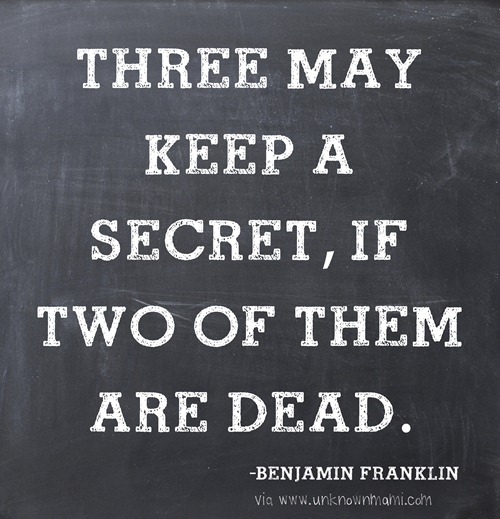
In the Scarlet Letter, there are two major secrets that take time to be revealed. First is Hester and Chillingworth's prior relationship. This secret was not told until Dimmesdale was at his weakest physical and emotional point. Arguably, it was told at too late a time to save him. Next is Hester and Dimmesdale's affair. This secret is the main source of conflict throughout the novel. It's what drives Chillingworth to transform from a noble scholar to a parasitic leech, sucking away on Dimmesdale's life. It is the "ultimate" sin that occurs and what the whole story is based off of.
Some secrets are meant to be revealed, while others are meant to stay hidden in the shadows. There can be many ways in which secrets are spread. They can be told one by one until a large population eventually finds out, similar to perfume exhibiting diffusion in an open room, spreading from a high concentration to a lower concentration. Secrets can also be told to a large mass of people at one time, just as Dimmesdale did. While the revealing of some secrets may have negligible effects on the individual, other secrets may profoundly impact his/her life. Sadly for Dimmesdale, his catharsis caused his death, but he died an honorable death in the eyes of the people.
You can't control secrets. You can, however, control when and if a secret becomes a public fact. Although secrets are often found out, some are meant to never be revealed.
Sunday, November 3, 2013
No One Likes a Liar
We all know that lying is bad, but can concealing valuable information be worse?
It is our human nature to try and protect ourselves and our loved ones. Whether it be through virtuous or unethical ways, protection is key to survival. In the Scarlet Letter by Nathaniel Hawthorne, Hester Prynne is a prime example where the concealment of information affects many of those around her.
In the beginning of the novel, Hester refuses to state the name of the father, which seems to save Dimmesdale from public scrutiny for the moment. Another instance where Hester conceals the truth is when she promises Chillingworth that she wouldn't tell anyone about their prior relationship. As a result, however, Dimmesdale slowly but surely grows weaker due to guilt. Since he is a sensitive yet virtuous man, his conscience is strong. Without the truth, he becomes more emaciated day by day.
In history, there have also been accounts where concealing information has led to costly consequences. The Watergate Scandal in the 1970s involved the breaking and entering into the Democratic National Committee headquarters at the Watergate complex. Additionally, it was revealed that President Nixon had a tape-recording system in his offices and he had recorded many conversations that the Democrats had. After failing to cover up his ploy, he had to resign from presidency.
A good moral we can learn from this is to always stay truthful, for "the truth can se you free." Unless you want to be like Pinocchio.


Sunday, October 27, 2013
Save Nature
With our growing dependence on technology and the dwindling image of nature, something needs to be done. Without nature, nothing can exist, for nature is the world and the world is nature.
Emerson states, "The sun illuminates only the eye of the man, but shines into the eye and heart of the child." I find this to be very true. As a child, I was much more connected with nature and its effects. I used to love playing outside, enjoying the sunshine with the songs of the birds. My favorite activity was, however, spending time in the woods next to my house. I was fascinated by all of the trees and wildlife that inhabited the area. I still remember the times where I would make tepees from the broken tree limbs and chase squirrels until they escaped into the canopy of the forest. Childhood was surely when I the closest to nature. In the following years, however, school and technology started consuming my life. Slowly but surely, nature started to fade away from my priorities.
In contrast to my evanescent relationship with nature, Ralph Waldo Emerson and the rest of the romantics devoted their lives to it. Through nature, there is peace and art. However, today there is less and less of nature. Emerson and other historical romantics would most certainly be dismayed by this fact. The sad truth is that nature's natural beauty is decaying day by day. With no slowing down of this trend, the world will eventually be eradicated of all nature including animals, forests, grasslands, etc.
We are the reason why nature is making its way towards extinction. All we can do is try our best to preserve it, whether it be in the forms of national parks or recycling. Everyone can make an impact.

Sunday, October 20, 2013
Am I Finally Free?
You can live for Freedom. You can die for Freedom. Today, we so often take freedom for granted. We have no idea what it is really like to be suppressed, ignored, or denigrated.
In a historical perspective, there have been multiple accounts where people fought for their freedom. In America alone, the colonists fought for freedom during the Revolutionary war; the slaves fought for freedom during the Civil War; the women fought for freedom during the 1920s; the African Americans fought for freedom during the Civil Rights Movement. Freedom is an essential element to our individuality--our dignity. Without freedom, we are nothing more than puppets being controlled by our masters.
Similar to the importance of freedom in history, fights for freedom still occur today. In the household, rambunctious children always dream of freedom. They dream of adulthood, away from the constraints of childhood. No longer will they be too this or too that. They dream of the day where they can finally make their own decisions, whether it be what to buy, where to go, or what to do.
Once adults, however, they are still not completely free. Most of the time, they will still be controlled in different ways. For example, there is no possible way of being fully liberated of restraints when in a relationship. If one were completely free, then the relationship would surely be transitory.
We may strive for freedom, but it is impossible to be entirely free. As Charles Kingsley put it, "There are two freedoms - the false, where a man is free to do what he likes; the true, where he is free to do what he ought."
Sunday, October 13, 2013
Blame them! Not me
Is the act of accusing an intrinsic part of human nature? Why is it that we always tend to place the blame on others except ourselves?
As Hal Borland said, "You can't be suspicious of a tree, or accuse a bird or a squirrel of subversion or challenge the ideology of a violet." He is very true on this point. Accusing is only what humans do to each other explicitly. Maybe it is part of our nature.
Directly relating to The Crucible, accusing is a major aspect of the play. Abigail and the girls all accuse others of being witches. Although there may be many motives for accusing people, it may or may not be for the correct reason. Abigail accuses Elizabeth because of spite while Proctor accuses Abigail because of his morals and love for his wife.
Accusing is also a major part of our nation's history. During the Red Scare, McCarthyism emerged because of the hysteria about communism. Many were falsely accused and were subject to hate by the rest of America. Although it was unfair, there was nothing at the time that could stop these accusations. Fear was in control.
Today, we still accuse people without even thinking twice about it. Whether it be a large scale problem or a simple "who ate the last cookie in the cookie jar" type of dilemma, accusing will always be part of who we are as people. We may even be able to go as far as to say that it's part of our DNA, but probably not.

As Hal Borland said, "You can't be suspicious of a tree, or accuse a bird or a squirrel of subversion or challenge the ideology of a violet." He is very true on this point. Accusing is only what humans do to each other explicitly. Maybe it is part of our nature.
Directly relating to The Crucible, accusing is a major aspect of the play. Abigail and the girls all accuse others of being witches. Although there may be many motives for accusing people, it may or may not be for the correct reason. Abigail accuses Elizabeth because of spite while Proctor accuses Abigail because of his morals and love for his wife.
Accusing is also a major part of our nation's history. During the Red Scare, McCarthyism emerged because of the hysteria about communism. Many were falsely accused and were subject to hate by the rest of America. Although it was unfair, there was nothing at the time that could stop these accusations. Fear was in control.
Today, we still accuse people without even thinking twice about it. Whether it be a large scale problem or a simple "who ate the last cookie in the cookie jar" type of dilemma, accusing will always be part of who we are as people. We may even be able to go as far as to say that it's part of our DNA, but probably not.
Sunday, October 6, 2013
They Be Cray
What is hysteria?
Hysteria, by definition, is a situation in which many people behave or react in an extreme or uncontrolled way because of fear, anger, etc.
As we have read in class the past week, The Crucible contains many cases of hysteria, whether it be the townsfolk, the people loyal to the court, or the young girls. In this story, you could say that there is a Domino Effect of hysteria. As the play begins, Abigail and the other girls are the first to exhibit hysteria. While in bed, Betty pretends to be in a coma, only waking to pretend to fly and show pain when hearing Jesus' name. With these antics, she, along with the other young girls, tries to convince the adults that there is witchcraft in the city. Eventually, the hysteria among the girls results in hysteria among the town as well. The first domino has fallen.
The girls have influenced the court, which has already hanged multiple citizens of Salem for conspiring with the Devil. Based on today's standards, the court in the play seems to be very harsh in manner. The only real evidence of witchcraft are through false witnesses and false confessions. The hysteria of the court forces the defendants to either confess or die, which doesn't seem very moral. With the accused being in a quagmire, their loved ones must fight for vindication; however, with the dominos toppling, more and more start to fall to hysteria.
Mary Warren, Proctor's servant, is a prime example of how hysteria can be "contagious." During Mary's questioning, Abigail and the girls all pretend to see Mary's spirit attacking them. Being emotionally fragile, Mary eventually breaks down in front of everyone in the room because of the girls' hysteria. Proctor's last domino has fallen.
Not only did hysteria exist back then, but it surely exists now and through all of history. During the Red Scare, hysteria still dominated the minds of many. America, at the time, was in chaos. Word of communists instilled fear in everyone. The lives of many innocuous citizens were on the brink of disaster. Despite the many accounts of hysteria, society still has not found the "cure" for it. We can only hope to avoid its consequences.
As Elia Kazan once said, "Whatever hysteria exists is inflamed by mystery, suspicion and secrecy. Hard and exact facts will cool it." If only we had more of these facts.

Hysteria, by definition, is a situation in which many people behave or react in an extreme or uncontrolled way because of fear, anger, etc.
As we have read in class the past week, The Crucible contains many cases of hysteria, whether it be the townsfolk, the people loyal to the court, or the young girls. In this story, you could say that there is a Domino Effect of hysteria. As the play begins, Abigail and the other girls are the first to exhibit hysteria. While in bed, Betty pretends to be in a coma, only waking to pretend to fly and show pain when hearing Jesus' name. With these antics, she, along with the other young girls, tries to convince the adults that there is witchcraft in the city. Eventually, the hysteria among the girls results in hysteria among the town as well. The first domino has fallen.
The girls have influenced the court, which has already hanged multiple citizens of Salem for conspiring with the Devil. Based on today's standards, the court in the play seems to be very harsh in manner. The only real evidence of witchcraft are through false witnesses and false confessions. The hysteria of the court forces the defendants to either confess or die, which doesn't seem very moral. With the accused being in a quagmire, their loved ones must fight for vindication; however, with the dominos toppling, more and more start to fall to hysteria.
Mary Warren, Proctor's servant, is a prime example of how hysteria can be "contagious." During Mary's questioning, Abigail and the girls all pretend to see Mary's spirit attacking them. Being emotionally fragile, Mary eventually breaks down in front of everyone in the room because of the girls' hysteria. Proctor's last domino has fallen.
Not only did hysteria exist back then, but it surely exists now and through all of history. During the Red Scare, hysteria still dominated the minds of many. America, at the time, was in chaos. Word of communists instilled fear in everyone. The lives of many innocuous citizens were on the brink of disaster. Despite the many accounts of hysteria, society still has not found the "cure" for it. We can only hope to avoid its consequences.
As Elia Kazan once said, "Whatever hysteria exists is inflamed by mystery, suspicion and secrecy. Hard and exact facts will cool it." If only we had more of these facts.
Sunday, September 29, 2013
Control or be Controlled by Religion
How does religion affect lifestyle?
Many know of the radicals in religion. From acts by members of the Westboro Baptist church to the Puritans in the Salem Witchcraft Trials, religion has greatly influenced people throughout all of history.
During the colonial period in America, the Puritans emerged as the dominant religious group. All aspects of life back then were focused around fearing God and obeying him. In "Sinners of an Angry God" by Jonathan Edwards, it can be seen that most people of the time truly believed that they must be born again in order to go to Heaven. Trying to keep themselves pure, people in this era were forced to follow the commandments or else be punished to public shame or death. An example of this is shown in an excerpt from "The Scarlet Letter" by Nathaniel Hawthorne. Hester Prynne commits adultery and is hated on by the public. One mistake against God's word leads to a world of shame that cannot be undone.
Today, religion still plays a role in how we live, but arguably it affects us much less than it used to. With America being "the land of the free," there is a multitude of religions that are prevalent. From Christianity to Islam, religion affects everyone differently depending on how zealous one is. Although religion is a major factor in the decisions we make, humans should still treat others the way they want to be treated. As Equiano writes, "Do unto all men as you would men should do unto you" (Equiano).

Many know of the radicals in religion. From acts by members of the Westboro Baptist church to the Puritans in the Salem Witchcraft Trials, religion has greatly influenced people throughout all of history.
During the colonial period in America, the Puritans emerged as the dominant religious group. All aspects of life back then were focused around fearing God and obeying him. In "Sinners of an Angry God" by Jonathan Edwards, it can be seen that most people of the time truly believed that they must be born again in order to go to Heaven. Trying to keep themselves pure, people in this era were forced to follow the commandments or else be punished to public shame or death. An example of this is shown in an excerpt from "The Scarlet Letter" by Nathaniel Hawthorne. Hester Prynne commits adultery and is hated on by the public. One mistake against God's word leads to a world of shame that cannot be undone.
Today, religion still plays a role in how we live, but arguably it affects us much less than it used to. With America being "the land of the free," there is a multitude of religions that are prevalent. From Christianity to Islam, religion affects everyone differently depending on how zealous one is. Although religion is a major factor in the decisions we make, humans should still treat others the way they want to be treated. As Equiano writes, "Do unto all men as you would men should do unto you" (Equiano).
Sunday, September 22, 2013
The Power of Stereotyping
How do stereotypes affect people in general?
Stereotype- an often unfair and untrue belief that many people have about all people or things with a particular characteristic.
 From stereotypes about race to stereotypes about gender, we all experience these generalizations almost on an everyday basis. Whether it be positive or negative, stereotypes continue to shape our first impressions about people we don't know. The famous saying, "never judge a book by its cover" is another way to view stereotypes. The cover (stereotype) does not directly relate to the book (personality).
Here are a few examples of common stereotypes:

Here are a few examples of common stereotypes:
- All Asians are good at math. All Asians like to eat rice and drive slowly.
- All blonds are unintelligent.
- All teenagers are rebels.
- All Arabs and Muslims are terrorists.
- All African Americans are athletic and scary/dangerous when wearing baggy jeans and long hoodies.
- All white Americans are obese, lazy, and dim-witted. Homer Simpson of the TV series The Simpsons is the personification of this stereotype, even though he has yellow skin.
Most of the time, stereotypes are regarded as negative. Humans judge other people without even noticing it. Although stereotypes may be true in some cases, there are many in which they aren't. In the story The Lone Ranger and Tonto Fistfight in Heaven by Sherman Alexie, the 7-11 scene shows the power of stereotyping. The fact that a "scary" Indian walks into the 7-11 store made the clerk uneasy. "He knew this dark skin and long, black hair of mine was dangerous. I had potential" (Alexie). Stereotypes have the power to invoke fear in people, even when there is nothing to fear.
Sadly, stereotyping can also lead to death, as with the case of Trayvon Martin. Only in these extreme cases do we actually realize true harm stereotyping can do. We can only learn from previous mistakes and hope to not remake them. The only way to prevent hurting others with stereotyping is to keep our own thoughts to ourselves. As the Golden Rule maxim states, "One should treat others as one would like others to treat oneself."
Sunday, September 15, 2013
The Power of Mindset
How much power does an individual yield?
A definition of power is an ability to act or produce an effect. Through ideas and perseverance, the individual can make a dream become reality. The only limiting factor in a person's power is the mind.
In The Adventures of Huckleberry Finn by Mark Twain, Huck initially has little power. He only had the power to go to school and obey his guardians. Power, however, is not stagnant. Huck's adventures allow his power to grow significantly. One of the first ways Huck demonstrates an improvement in power is when his father kidnapped him. While in the cabin, Huck is able to use intelligence to escape. He even stages his own death and manages to deceive the whole town. Despite the fact that Huck is more of a follower than a leader, he still has the power to change a life for the better. At the end of the novel, Huck shows that he has the power to escape from home, survive with Jim during a long journey, and ensure Jim's freedom. Although he had internal conflicts, Huck is an example of how mindset affects power.
Power does not come from concrete things like money or strength, but rather it comes from what you can do to change a situation. In the novel 1984 by George Orwell, Winston is merely a worker in the eyes of Big Brother. The omniscient telescreens instill fear or the citizens of Oceana. Even though Winston lives in a dystopian society, he still has power through the mind and his belief in the Resistance. Winston is completely devoted to Julia and changing society. He is, however, caught in the process. Although the totalitarian government depletes Winston of his dignity, he still demonstrates the power of perseverance.
Famous inventors like Thomas Edison have power. Ordinary workers who help the community have power. From the little kid down the street to the CEO of Apple, everyone has the potential to increase their power. As to how much power does an individual yield? It all depends on how much the individual strives for and what he/she intends to do with that power. After all, "with great power comes great responsibility."
A definition of power is an ability to act or produce an effect. Through ideas and perseverance, the individual can make a dream become reality. The only limiting factor in a person's power is the mind.
In The Adventures of Huckleberry Finn by Mark Twain, Huck initially has little power. He only had the power to go to school and obey his guardians. Power, however, is not stagnant. Huck's adventures allow his power to grow significantly. One of the first ways Huck demonstrates an improvement in power is when his father kidnapped him. While in the cabin, Huck is able to use intelligence to escape. He even stages his own death and manages to deceive the whole town. Despite the fact that Huck is more of a follower than a leader, he still has the power to change a life for the better. At the end of the novel, Huck shows that he has the power to escape from home, survive with Jim during a long journey, and ensure Jim's freedom. Although he had internal conflicts, Huck is an example of how mindset affects power.
Power does not come from concrete things like money or strength, but rather it comes from what you can do to change a situation. In the novel 1984 by George Orwell, Winston is merely a worker in the eyes of Big Brother. The omniscient telescreens instill fear or the citizens of Oceana. Even though Winston lives in a dystopian society, he still has power through the mind and his belief in the Resistance. Winston is completely devoted to Julia and changing society. He is, however, caught in the process. Although the totalitarian government depletes Winston of his dignity, he still demonstrates the power of perseverance.
Famous inventors like Thomas Edison have power. Ordinary workers who help the community have power. From the little kid down the street to the CEO of Apple, everyone has the potential to increase their power. As to how much power does an individual yield? It all depends on how much the individual strives for and what he/she intends to do with that power. After all, "with great power comes great responsibility."
Subscribe to:
Posts (Atom)